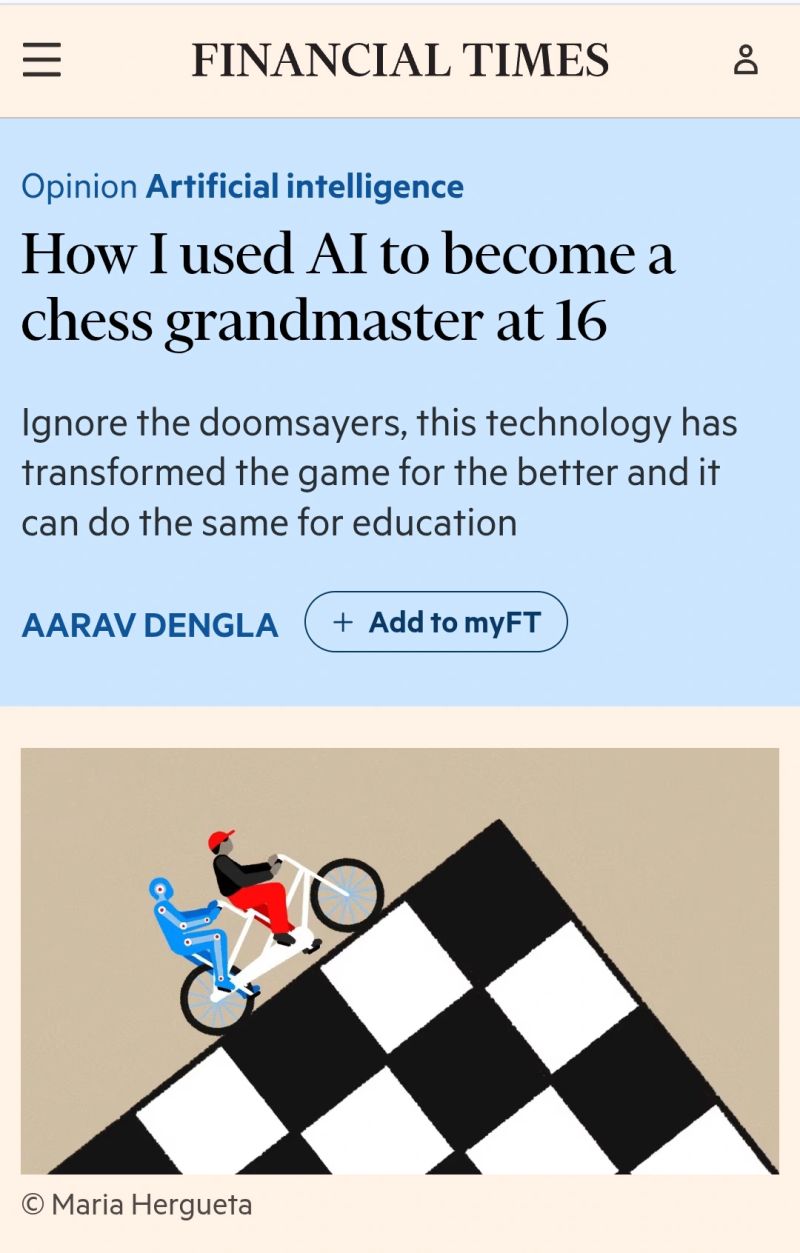
The opinion article "How I used AI to become a chess grandmaster at 16" is one…
EN
The opinion article "How I used AI to become a chess grandmaster at 16" is one of the poorest pieces of argumentation in favour of AI in education that I have read recently.
Since I have no knowledge of competitive chess, the text was even more confusing on a first reading. In the beginning, the author associates the use of two chess engines directly with his victory, and only in the following paragraph does it become clear that the engines were used for preparation the night before. Their use during official games is actually forbidden.
Once this is clarified, his analogy between competitive chess and education proves weak, firstly because chess engines and LLMs are different technologies. Engines operate in a closed domain with verifiable output, unlike LLMs. Plus, the evidence he presents is based on a closed circle ("serious players"), not the average student. Chess players at this level are highly motivated people with a strong objective, i.e. competition, for which they prepare intensively. Students may not have such motivation.
We can compare this to sport and physical exercise, whose benefits depend on the conditions:
a) competition: high motivation, systematic preparation.
b) recreational play: voluntarily and for enjoyment.
c) compulsory physical education at school: young children may not perceive the benefit of the activity and have no intrinsic motivation for it.
d) the simulation of play or the observation of others playing: familiarity with the game but does not develop physical capacity.
The author's experience corresponds to (a), whereas much of formal education is more about (c), sometimes aspiring to be (b). A student who reads answers produced by an LLM is closer to (d).
One valid proposition is that assessment should remain AI-free, and it coincides with what a number of institutions already propose.